As part of the RAAF Development Plan, the Air Board gave approval in May 1942 to develop three airfields in the Central Midlands of Tasmania. The airfields were developed at Valleyfield, Tunbridge, and Quorn Hall at an estimated total cost of £200,000.
Valleyfield
Long-range Fighter Squadron base
Tunbridge
Dive Bomber Squadron base
Quorn Hall
Maintenance echelon for both squadrons
Construction was largely complete by January 1943. With the changing course of the war, however, the airfield was never used by any operational units. In November 1943, operational control of Tunbridge was passed to the Number 7 Elementary Flying Training School, which was based at Western Junction — now Launceston Airport.
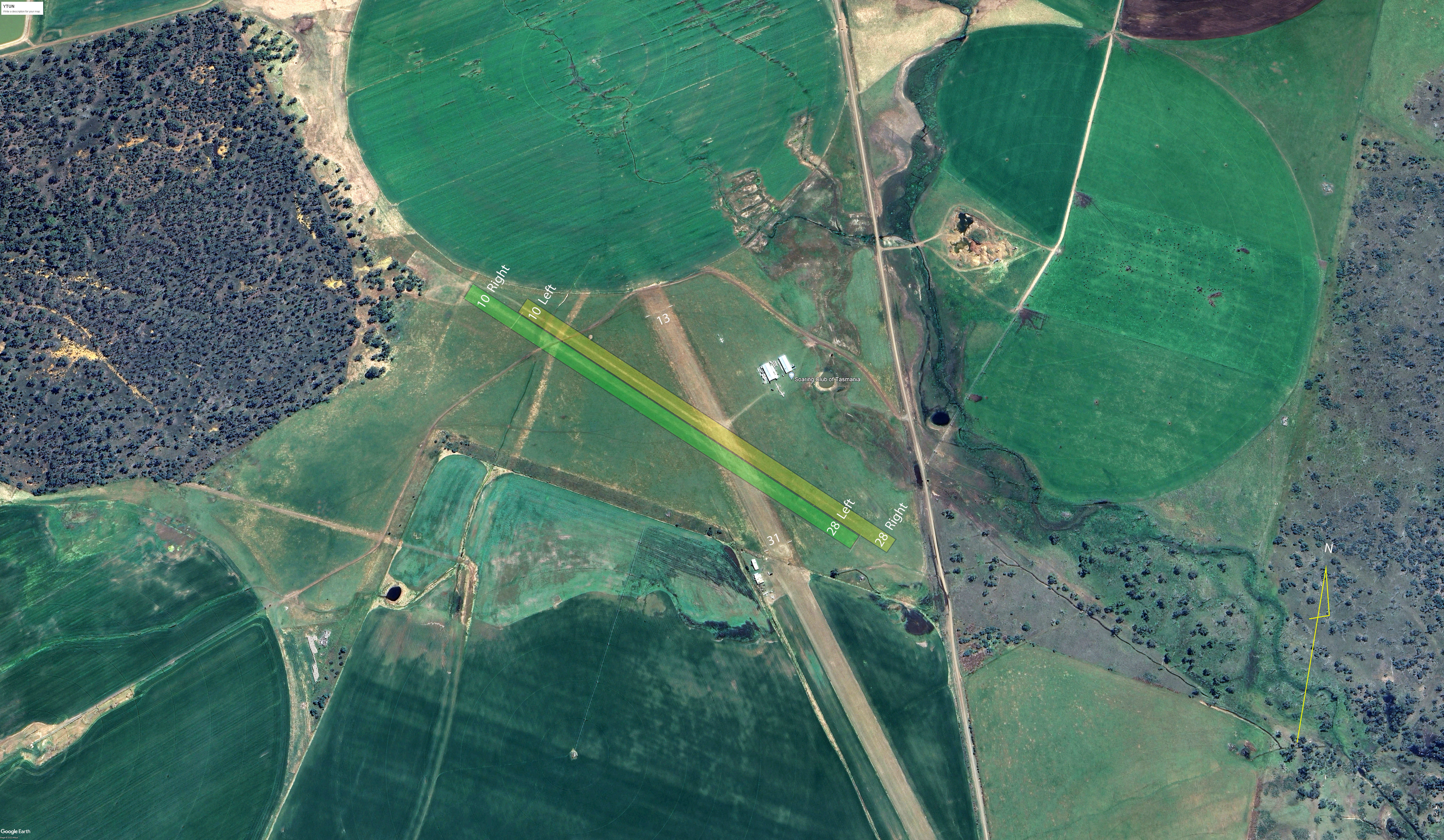
The original airfield comprised three runways with taxiways and aircraft dispersal bays. The runways were aligned at 135°, 52°, and 93°.
The airfield's post-war years brought an unexpected chapter in Tasmanian motorsport history. In March 1950, the Southern Motor Cycle and Light Car Club drew around 250 entries to Tunbridge for speed trials and circuit races — one of the largest motorsporting gatherings the state had seen. Riders and drivers pushed the limits of the long runways, with some of the state's fastest machines recorded at speeds approaching 160 km/h. The races attracted competitors from across Tasmania, with notable wins by Hobart's Don Gorringe in the car events and D. Powell in the sidecar class.
The popularity of Midlands airstrip racing during this period had a lasting legacy for Tasmanian motorsport. Enthusiasm generated by events like those at Tunbridge helped drive the establishment of dedicated circuit racing at Longford in 1953, and ultimately the opening of Baskerville Raceway in 1958 — venues that became part of Australian motorsport history in their own right. (Source: The Mercury, "Blast from the Past" — Damian Bester)
The Airfield Today
Runways at 135° and 52° are still visible on Google Earth satellite imagery, though the 93° runway is barely discernible. The northern half of the 135° (North/South) runway remains in use, and Gliding Tasmania has also developed a 900-metre runway at 280°.
The airfield is a large paddock. Runway 28/10 is the dual main runway (Landing left, takeoff right). Visitors flying in should take care as the strips can be hard to identify, particularly in poor lighting. They are marked by white cones on the main North/South strip and are most apparent after mowing.
Pilots should be aware of livestock occasionally on the field, and wild deer that inhabit nearby forests and sometimes cross the operating area.